
As a teacher, I have seen an increase in the number of students who struggle with regulating behaviors, emotions, and other soft skills. I know I am not alone in experiencing the students who are struggling with behaviors and demanding more time and attention than the classroom teacher can give. So what can we do about it? This is the reason I started Engaging SEL. I was one of those teachers dealing with increasing behavior problems without strategies to help the students. Of course, there is no one-size-fits-all solution for behavior problems, but one thing we can do as teachers is teach students self-regulation skills to help stop the meltdowns before they start. In this blog post, we will explore self-regulation and what teachers can do in their classrooms to support self-regulation in their students.
What is Behavior Regulation?
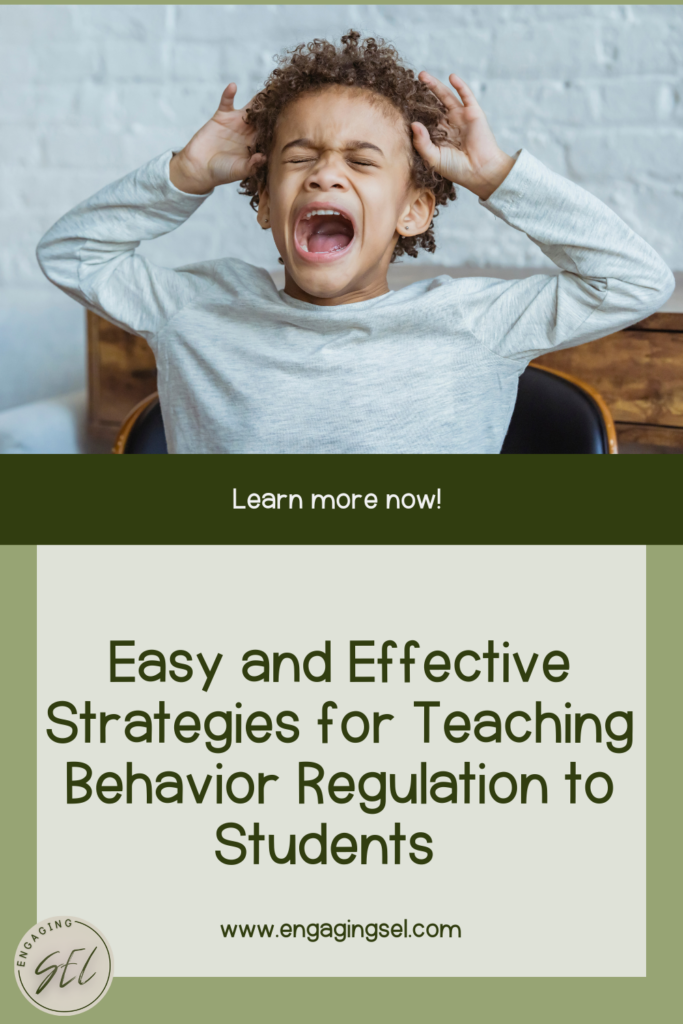
According to NCFL, self-regulation is the ability to manage one’s movements, emotions, thoughts, attention, and behavior, and allows the person to control impulses in order to react or respond to situations appropriately. Most students learn these skills in their early years through a caregiver or caring adult. However, some children may struggle with these soft skills into their school-age years, which may lead to tantrums, meltdowns, or aggressive behaviors in the classroom. These children need support in learning to recognize when they are getting upset, starting to lose focus, or losing control (Responsive Classroom). Emotional and behavioral regulation can be taught in the classroom to help students manage their emotions and behavior in socially acceptable ways.
Behavior Regulation in the Classroom
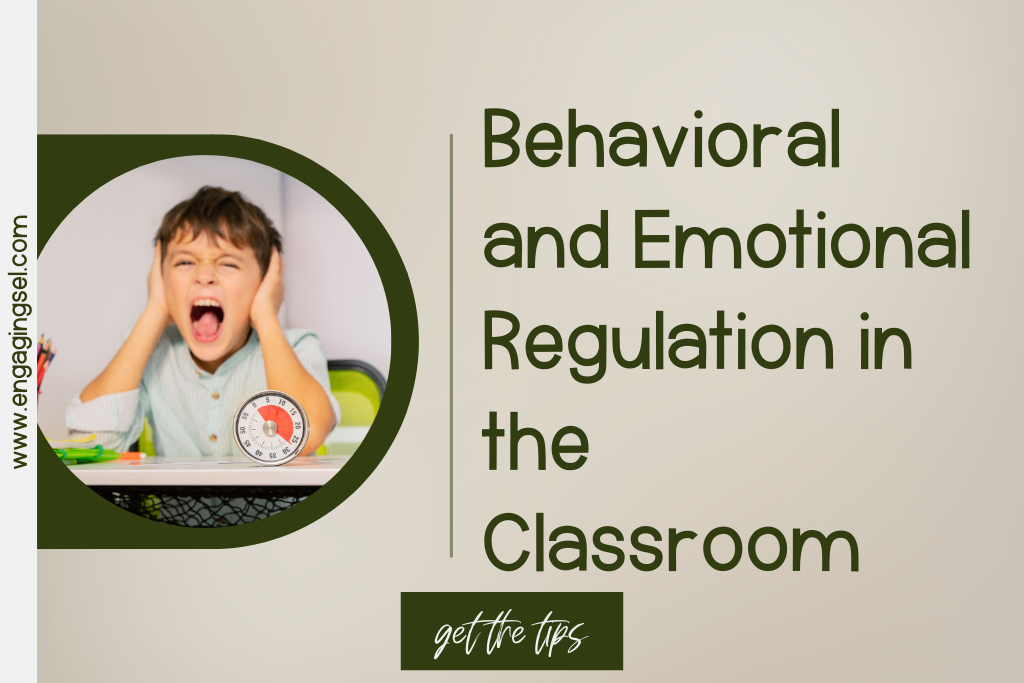
Teachers are more effective when we can teach without disruptions, so it’s a no-brainer that we want our classrooms to run as smoothly as possible. That might not always be the case, but if we give our students the tools to regulate their behaviors on their own and teach them how to use those tools, we can decrease the disruptions. Not all children learn in the same way, and some students may benefit from more explicit instruction in the soft skills, such as regulation strategies. Teaching students behavior regulation skills, giving them practice using these skills, and building in scaffolds throughout the day can support students who struggle with behaviors in a way to “rescue” themselves when difficult situations arise. ChildMind Institute recommends teaching this skill the same way we teach academic skills in the classroom: isolate the skill, provide practice, coach kids through difficult situations, and provide a supportive framework until they can handle the challenges on their own. Teachers can use explicit lessons on behavior regulation to teach the skill to their students. My Regulating Behaviors and Emotions Unit is a great place to start when teaching these skills to students.
Behavior Regulation Strategies
Behavior regulation is not something that will happen overnight. It takes time and practice to develop these skills. Most children in your class will likely have a good handle on this skill already, but everyone can benefit from adding these strategies to their toolbox. Next, I will share some of the strategies I use in my classroom to help students regulate their behaviors.
Breathing
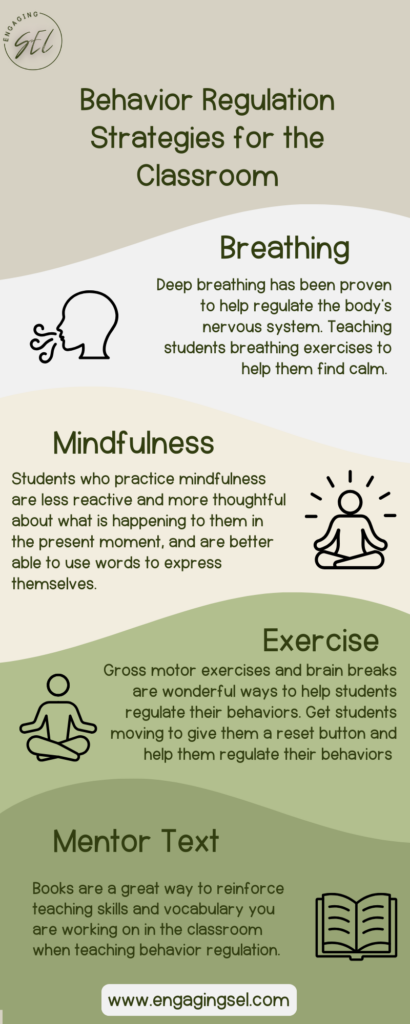
Dr. Paul Holland explains how breath sends signals to the brain and how deep breaths help to regulate the body’s nervous system. Students can practice breathing exercises to help them calm their bodies and regulate their emotions and behaviors. I recommend that these exercises be taught during a calm state in order for students to be able to access this strategy during a time of dysregulation. I love to use these mindfulness and breathing exercises during the morning meeting every day so students can practice the ones they like and add them to their “toolbox”.
Mindfulness
Mindfulness is a type of meditation that focuses on being aware of what a person is sensing or feeling in the moment without judgment. Observing the thoughts, feelings, sensations, and emotions objectively helps achieve a state of calm. To learn more about mindfulness in the classroom, read the blog What is Mindfulness and the Benefits of Mindfulness in the Classroom. Mindfulness helps students build emotional intelligence by teaching them to observe their emotions in the present moment without judgment. Students who practice mindfulness are less reactive and more thoughtful about what is happening to them in the present moment, and are better able to use words to express themselves.
Activities and Exercises
Gross motor exercises and brain breaks are wonderful ways to help students regulate their behaviors. Students need frequent breaks during the day to reset, and one of my favorite things to do with students is to have a fun brain break. There are tons of options on the internet, like GoNoodle, Danny Go!, Cosmic Kids, and other YouTubers. Games that teach skills like active listening, self-control, and patience, such as Red Light Green Light or Simon Says, are great choices too.
Calm Down Area
One of my classroom must-haves is a calm-down space! Classrooms should have an inconspicuous space inside the classroom, in view of the teacher, where students can go to take a break or to help them get back to calm when they are feeling big emotions. I have mine stocked with fidgets, feeling books, sand timers, and all sorts of other tools. Having a calm area in my classroom has been the biggest game-changer when it comes to behavioral and emotional regulation. It takes a lot of time to teach students how to use it initially, but if you introduce it the right way, students can use this space to help them regulate when they are having a hard time.
Read Alouds and Mentor Texts
Students need direct exposure to the vocabulary and skills related to behavior regulation and lots of practice before they are able to apply the skill independently. Read-alouds are a great way to expose students to the language and skills related to behavioral regulation. I love using read-alouds to start my day, so what better way to reinforce the skills you are trying to teach than with a great book! The Responsive Counselor has a great list to start off with here.
To summarize, students need to be explicitly taught how to regulate their behaviors in the classroom. Teachers can use breathing, mindfulness, exercises, activities, read-alouds, and lessons or curriculum to directly teach these skills. Teaching your students these strategies and tools is a great way to support behavior regulation in the classroom. When students can learn tools and strategies to help them manage and regulate their behavior, they are able to regulate themselves and keep meltdowns to a minimum, which contributes to a calmer classroom environment. I would love to hear how you were able to use these ideas to teach behavior regulation. Please comment and share your success or any questions you have. I am looking forward to hearing from you. Email me at alyssa@engagingsel.com. Thank you,
Alyssa from Engaging SEL